Where your treasure is, there your heart will be also
 On the Sunday before the beginning of Lent in the Eastern Church, we shall hear the passage from the Gospel of Matthew: “For if you forgive men their trespasses, your heavenly Father will also forgive you. But if you do not forgive men their trespasses, neither will your Father forgive your trespasses. Moreover, when you fast, do not be like the hypocrites, with a sad countenance. For they disfigure their faces that they may appear to men to be fasting. Assuredly, I say to you, they have their reward. But you, when you fast, anoint your head and wash your face, so that you do not appear to men to be fasting, but to your Father who is in secret; and your Father who sees in secret will reward you openly. Do not lay up for yourselves treasures on earth, where moth and rust destroy and where thieves break in and steal; but lay up for yourselves treasures in heaven, where neither moth nor rust destroys and where thieves do not break in and steal. For where your treasure is, there your heart will be also.” (Mt 6:14-21)
Reflection on Pro 3:5-6
 Trust in the Lord with all your heart, and lean not on your own understanding. In all your ways acknowledge Him, and He shall direct your paths.
There is wise counsel in the Book of Proverbs, which is rooted in age-old experience: “Trust in the Lord with all your heart.” God speaks to man through His word, but also secretly through various life situations. It is important to know first when exactly I should trust in the Lord. Above all, I should trust in Him in the face of trial. I should also trust in Him when asking for wisdom in a situation that is unclear and not easy to navigate. Our trust is then manifested in prayer.
Testimony: More than thirty years ago, a young man visited a group of believers. They encouraged each other, and then one of the believers asked the young man, “Why do you have a crutch?” He replied, “I’ve had a motorcycle accident and my knee won’t work properly any more. Thank God it wasn’t worse. I have to come to terms with that crutch, get used to it. My sick leave was not extended and due to that leg, I will be receiving a partial disability pension.” One of the brethren suggested, “Why not pray for it? Perhaps the Lord will enlighten us on this.”
Reflection on Ecc 12:14
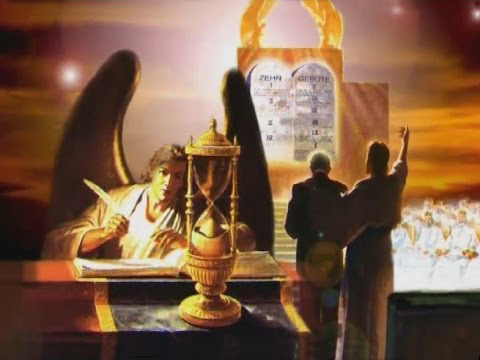 God will bring every work into judgment, including every secret thing, whether good or evil.
This is the last verse of the Book of Ecclesiastes. Realize that everything you do is filmed by invisible cameras and stored in your soul, and it is all seen by angels too. Not only the holy angels but also the evil ones see everything, and will accuse you before God’s judgment seat. Modern technology with ubiquitous cameras monitors and records many human actions and preserves them as evidence. This human technology is mere child’s play in comparison with the spiritual principles and laws that apply in the spiritual world. Be aware that you are not hidden anywhere; God sees you everywhere. He even sees into your heart and examines your thoughts and feelings. Nothing is hidden from Him. He has given you freedom. When you do good, you show gratitude to God and His reward awaits you. When you do evil, God is grieved by the evil done, and He often allows suffering in your life to make you stop and begin to take care of your soul.
Reflection on Jn 16:33
 “These things I have spoken to you, that in Me you may have peace. In the world you will have tribulation; but be of good cheer, I have overcome the world.”
These are important words; we have to realize that we only have true peace in Christ. He says in another place: “The peace I give is a gift the world cannot give.” This peace is connected with a living faith, commitment to Christ, and a clear conscience. A person who does evil and has abandoned Christ can only have a false peace and never a true one.
Jesus foretells that in the world we will have tribulation. Every man on earth has tribulation and cannot escape it. It arises from a number of sources: not only from other people or from the system of the world and a certain disharmony in it, but also from our helplessness and the fact that evil works in us. We ourselves are often the authors of our own suffering. Therefore we must learn to perceive material, mental and spiritual laws, and thus acquire life wisdom. But it is mainly the Holy Spirit who gives us the light of true wisdom and enlightens us. Many times young people can have the wisdom of the elders if, as the Scriptures say, they seek to know and keep God’s Word.
Reflection on Jn 16:32
 “Indeed the hour is coming, yes, has now come, that you will be scattered, each to his own, and will leave Me alone. And yet I am not alone, because the Father is with Me.”
After the words “each of you will be scattered”, the Greek original of the Holy Scriptures continues: “eis ta idia”, that is, “to his own”. The term “eis ta idia” is used once more in the Gospel of John to describe the moment when Jesus entrusted His Mother to the disciple. Jesus said: “Behold, your mother.” And the Apostle and Evangelist John, who stood by the cross and heard those words in person, writes: “And from that hour that disciple received her – eis ta idia – into his own.” We can say – inside himself. It required an act of faith. It was a spiritual transplantation of a new heart. We are the offspring of the first woman, Eve, who is in us along with the genetic code of original sin. In spiritual terms, we can liken it to a devilish spiritual mRNA vaccine, which injects a spiritual poison called sin. Every day we see how original sin works in us; this is the greatest reality.
Reflection on Heb 1:1-2
 “In the past God spoke to our forefathers through the prophets at many times and in various ways, but in these last days He has spoken to us by His Son, whom He appointed heir of all things, and through whom He made the universe.”
As we read the Old Testament, we learn that God indeed spoke to the chosen nation at many times, especially through the prophets and in many other ways too. God also spoke by demonstrating good, whether it was deliverance from Egypt, passage through the Red Sea, or miracles in the wilderness, and He also spoke through various trials, and then through warning punishments, not only in the wilderness but throughout the history of Israel. Often the nation was blind and deaf, and then God sent upon it harsh trials such as wars, Babylonian captivity… God gave man free will, but the evil that man does brings suffering both to him and others, and therefore God punishes him, either here in time or in eternity if he does not repent in earnest. God spoke and rebuked the nation through the prophets, but the nation responded by stoning and killing His prophets, and their sons built their tombs.
Reflection on Heb 12:1-2a
 “Therefore, since we are surrounded by such a great cloud of witnesses, let us throw off everything that hinders and the sin that so easily entangles, and let us run with perseverance the race marked out for us. Let us fix our eyes on Jesus.”
The Word of God says that we are surrounded by a great cloud of witnesses. They are especially spiritual beings, angels, who are witnesses of our life. God speaks to us through them, too – for example, a saving thought flashes through our mind in a crisis situation. Unfortunately, we often cast it aside and pursue the vision of sin. Therefore, the Scriptures encourage us to throw off everything that hinders and the sin that so easily entangles. Our life is like a strenuous run to reach the heavenly goal through various obstacles. In this run we are to have our eyes fixed on Jesus! He is, as the Scripture continues in verse 2, “the author and perfecter of our faith”, because He guides our faith from the beginning to the end along the narrow way of the cross until we obtain the eternal crown in the joy of heaven. We should be aware that we are surrounded by a cloud of witnesses – angels.
Reflection on Jn 16:2-3
 They will put you out of the synagogues; yes, the time is coming that whoever kills you will think that he offers God service. And these things they will do to you because they have not known the Father nor Me.
Jesus begins this passage by saying: “These things I have spoken to you, that you should not be made to stumble.” Jesus tells the apostles, as well as countless Christians throughout history, that those who are faithful to Him will be persecuted and expelled from the synagogues, that is, from the official Christian community. Today we can see that the Church of Christ is occupied by ecclesiastical leaders, such as pseudo Pope Bergoglio and other pseudo bishops, we will not name any, who are like the vinedressers that Jesus speaks about in the parable. They have seized God’s vineyard and Christ’s servants, and even mistreated the Son of God Himself and killed Him in the souls. They have replaced the Son of God, who is the owner of the vineyard – the Church, with the Pachamama demon. God allows it, but ecclesiastical criminals will not escape God’s judgment and just punishment. In the present hour of darkness, these invaders and their collaborators form the public opinion in such a way that whoever kills true diciples of Christ will really think he offers God service.
Reflection on Jn 15:18-19
 If the world hates you, you know that it hated Me before it hated you. If you were of the world, the world would love its own. Yet because you are not of the world, but I chose you out of the world, therefore the world hates you.
Jesus speaks about hatred on the part of the world. By the world here is not meant beautiful nature but the thinking that defies the truth and places vanity and the pride of life at the centre. Why? Because the prince of this world, as Jesus calls him, is the spirit of lies and death. With the first sin disharmony entered not only the human heart but also the material world. The Word of God says that the world lies under the sway of the wicked one (1Jn 5:19) and hates God (Jn 15:18). This world is the opposite of everything that comes from the will and wisdom of God (1Cor 1:20-27; 3:19; Jn 14:17; 15:19). The answer to the question of how the form of this world can be compared with the Bible’s account of God creating a good world (Gen 1:31) is given in Romans 5:12, where the Apostle Paul states that through one man sin entered the world, and death through sin. However, it did not happen according to the necessity of fate, but through an act of human will, disobedience and obstinacy.
Reflection on Jn 15:7
 If you abide in Me, and My words abide in you, you will ask what you desire, and it shall be done for you.
This is an extraordinarily great promise! Jesus says: You will ask what you desire, and it shall be done for you. Of course, this has its limitations, as we cannot ask for things that are bad or harmful. Next, there are also two conditions: we should abide in Christ, and His words should abide in us. If we fulfil these conditions, being truly united to Christ by faith and surrendering to God’s will according to His word, we will surely ask for things which are in accord with God’s will. This is the will of God – our salvation, that is, our ultimate good. It is God’s promise that He will hear our prayer from this perspective. We should know that many times when we ask for something, even a hard trial, i.e. a certain evil, may work out for our eternal good. If we remain faithful to Christ in the face of this suffering, this trial will eventually bring us even more blessing and good than we specifically asked for. Therefore, it is important that when we ask God for a certain thing, we should be in a position of agreement with our ultimate good and the good of those we carry in our heart.
Reflection on Jn 15:5
 I am the vine, you are the branches. He who abides in Me, and I in him, bears much fruit; for without Me you can do nothing.
Jesus says these words at the Last Supper, while revealing to the apostles the profound mystery of unity between Him and those who have received Him, and between Him and the Heavenly Father. This relationship, which is in fact the new life or God’s life in us, is secured by our connection to Jesus, just as the branches are connected to the vine, which is Christ. We, the branches, are nourished on the same life-giving sap. The Holy Spirit is our life-giving sap.
Jesus indicates in these verses that the condition for us to bear fruit is to abide in Him. We should then allow Him to live in our soul by making little sacrifices, by renouncing our will, so that He may work through us and promote the will of God.
Reflection on Rev 20:4b
 Then I saw the souls of those who had been beheaded for their witness to Jesus and for the word of God, who had not worshipped the beast or his image, and had not received his mark on their foreheads or on their hands.
In another vision, the Apostle John saw those who had been beheaded for their witness to Jesus and for the word of God. The reason why they were killed was that they had not worshipped the beast or his image, and had not received his mark on their foreheads or on their hands. The Apostle then says that they reigned with Christ. It is also written that over such the second death, that is hell, has no power. Before this vision, the Apostle gives the following description: “And I saw the beast, the kings of the earth, and their armies, gathered together to make war against Him who sat on the horse and against His army. Then the beast was captured, and with him the false prophet who worked signs in his presence, by which he deceived those who received the mark of the beast and those who worshipped his image. These two were cast alive into the lake of fire burning with brimstone.”
Reflection on Rev 15:2
 And I saw something like a sea of glass mingled with fire, and those who have the victory over the beast, over his image and over his mark and over the number of his name.
The Apostle John was given a vision of the future of the Church. This whole vision, which the Apostle expresses through images of angels and various catastrophes, revealing spiritual battle with the devil and his angels – demons, ultimately ends with the casting of Satan into the lake of fire and the coming of God’s kingdom in glory. In several places of his revelation, he points to a so-called mark which the beast will force on all people. The Apostle warns against this mark of the beast and points out the terrible consequences of the mark. We feel that this testimony applies in an extraordinary way to our present. That is why we need to be very careful and vigilant, because this danger is linked to eternal punishment. On the other hand, he who overcomes shall receive an eternal reward in heaven.
Reflection on Rev 14:11
 And the smoke of their torment ascends forever and ever; and they have no rest day or night, who worship the beast and his image, and whoever receives the mark of his name.
These words, too, are extremely topical at this time we are going through, and they are a clear warning. They warn people not to receive the mark of the beast’s name or to worship him and his image. It means not to pay divine honours to the beast because divine honours belong to God alone. As for those who take no heed of the warning, laugh at it or make their own interpretation so as to avoid the least sacrifice, the Scripture says to them: “Their torment ascends forever, and they have no rest day or night” already in this life and unquenchable eternal torment awaits them.
The previous verse reads that if anyone receives the mark of the beast, he himself shall drink of the wine of the wrath of God and shall be tormented with fire and brimstone in the presence of the holy angels. So it clearly speaks about an extremely great suffering, and also about its length. Then it is emphasized that this suffering will last forever. Why? Because by receiving the mark of the beast a person renounces his own will and is no longer able to make an act of perfect contrition.
Reflection on Rev 13:16
 “He forces all, both small and great, rich and poor, free and slave, to receive a mark on their right hand or on their foreheads.”

For two thousand years, believers read these words and they remained shrouded in mystery. But now they have become extremely topical.
It is now the second year we have been going through a period that began with an artificial Covid-19 pandemic connected with lockdowns. Thus, the ground was gradually prepared for mass vaccination and associated chipization of humanity. In recent days, a report has been published about the invention of a miniature microchip that can be injected through a needle. We get into a situation when even those who are quite clear about this issue can be trapped. For example, when visiting a dentist, a microchip may be inserted into their body with the dental anaesthetic injection. Of course, the question of voluntariness also plays a role here. Whoever receives the mark of the beast in a chip voluntarily is subject to the punishment mentioned in the Bible. Whoever receives a chip through no fault of his own but rather by fraud becomes an innocent victim and bears no personal guilt.
Reflection on Jn 14:21
 “He who has My commandments and keeps them, it is he who loves Me. And he who loves Me will be loved by My Father, and I will love him and manifest Myself to him.”
The condition for an interior knowledge of Jesus is to receive His commandments. But this is not enough. We also need to keep them. The keeping of Jesus’ commandments is a sign of our love for Him.
Why should we love Jesus? Because He first loved us, took our sins upon Himself, and paid for them by shedding His blood and dying on the cross. He thus obtained for us eternal happiness in heaven. The first stage of love is gratitude at the least. Even a dog can be grateful to someone who has done him good. Or even a predatory animal, as we see in the example of the lion in the life of St Gerasimos. After the saint removed a thorn from the lion’s paw and cleansed the wound, the lion helped him faithfully in return. Finally, full of gratitude to his benefactor, the lion died of grief at the saint’s grave.
Actual VIDEO
- BCP: A Call for a Revolution in the Catholic Church – From the Head (Part 2)
- BCP: A Call for a Revolution in the Catholic Church – From the Members (Part 1)
- BCP: Was Pope Francis a public heretic or not? Part 13
- BCP: Was Pope Francis a public heretic or not? Part 11
- BCP: Was Pope Francis a public heretic or not? Part 9