The Epiclesis /Part four: The Epiclesis – The Temple and Iconostasis/
26 November 2018
 The biblical model of the Christian temple is the vision given by God (to Moses). It was applied to the Jerusalem Temple. The basic structure consists of the Holy of Holies, where God is present in a special way, the Holy Place, where the priests offered sacrifices to God, and the place for people.
The Eastern temple with an iconostasis, altar and tabernacle has preserved this biblical structure to this day. The Western Church had preserved it only until the Second Vatican Council which carried out an absurd reform. After the reform, the priest, who represents the people and offers sacrifice to God on the altar in their behalf, has turned his back to the centre of the temple, which is the tabernacle where God’s presence dwells constantly. Moreover, in many places the tabernacle has been removed from the centre of the temple. The reform has also removed the rail which separated the place for priests and for those who served at the altar.
The Epiclesis /Part three: The Epiclesis – How to experience the Epiclesis in the Liturgy/
25 November 2018
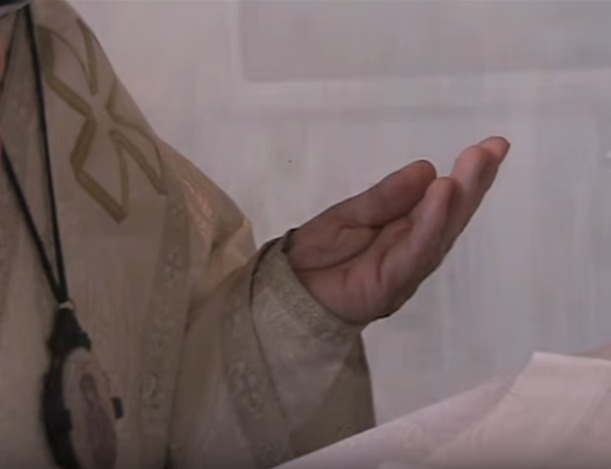 The Epiclesis is the invocation of the Holy Spirit both on us and on the gifts. It has three parts:
1) The priest kneels and implores God in a spirit: “Send down the Holy Spirit upon us” (Note: Throughout the Epiclesis, the chorus sings the antiphon: “We praise You…” or there is silence).
God promises through the prophet Ezekiel (37): “Behold, I will send spirit into you, and you shall live.” – We beseech in spirit: Lord, give us the Spirit of repentance, that we may live!
“I will put sinews on you” – Put sinews on us – the gift of prayer!
“I will bring flesh upon you” – Fill us with the power of Your commandments!
“I will cover you with protective skin” – Give us living communities!
“I will put Spirit in you, and you shall live” – Put the fullness of the Spirit in us, that we may live! Ye-ho-shu-aaa
The Epiclesis /Part two: The Holy Spirit and the Epiclesis/
22 November 2018
 Before His death, before sacrificing His body and blood on the cross, Jesus established this sacrifice of the cross to be offered to God for the remission of sins. The symbolic sin-offerings, when the blood and life of the sacrificial lambs was offered in the Jerusalem temple, lost their significance. Jesus is the true Lamb who took on Himself the sins of the world (Jn 1:29). Before the completion of His sacrifice of the cross, Jesus instituted a new sacrifice, which is also a new covenant (Mt 26:26) for the forgiveness of sins. At the Last Supper, He took bread and said, “This is My body, which is given for you.” Then He took the cup of wine and said, “This is My blood of the new covenant, which is shed … for the remission of sins.”
What about the Apostles? What did they think? They did not understand His words because His sacrifice had not yet been accomplished. During the Last Supper, Jesus also spoke a number of times about the Holy Spirit, “I still have many things to say to you, but you cannot bear them now. However, when the Spirit of truth has come, He will guide you into all truth.” (Jn 16:13)
The Epiclesis /Part one: The Difference between Eastern and Western Liturgy/
21 November 2018
Part one: The Difference between Eastern and Western Liturgy, the Question of Epiclesis
Part two: The Holy Spirit and the Epiclesis
Part three: How to experience the Epiclesis in the Liturgy
Part four: Liturgical Space and Iconostasis
Part one: The Difference between Eastern and Western Liturgy, the Question of Epiclesis
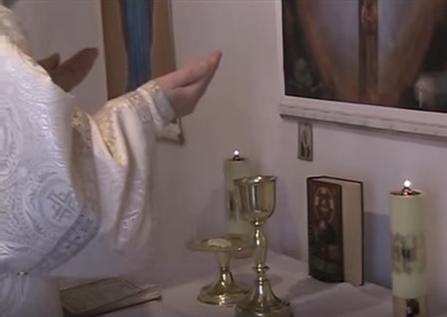 The Eastern Liturgy of St Basil the Great and St John Chrysostom (4th century) contains the Epiclesis. The Epiclesis is also found in other Eastern rites. It comes directly from the Apostolic Tradition.
What is the difference between Eastern and Western Liturgy? The Western Liturgy was radically modified at the Second Vatican Council. The reform introduced four Canons instead of one. The pre-conciliar Latin Liturgy had no mention of the Holy Spirit in the Canon. The reformed conciliar Liturgy does make mention of the Holy Spirit but it has been inserted before the words of Institution. Unlike the Latin Liturgy, the Eastern Liturgy includes a so-called intense invocation of the Holy Spirit, or the Epiclesis, after the words of Institution.
The Bible and morality
November 7, 2018
 Life is a test which decides whether we will have a happy or unhappy eternity. The biggest reality is death. The purpose of life is not the pursuit of sensual pleasures, the less so becoming their slave. The purpose of life is to seek the truth, to love it, to sacrifice ourselves for it, and, if necessary, even to die for it. Jesus Christ, the only begotten Son of God, is the Truth Incarnate. We who have accepted the Truth – Jesus – become the adoptive (second-born) sons and daughters of God (cf. Jn 1:12). God wants us to save our souls for eternity (cf. Mk 8:35; Jn 12:24). If we actively enter into spiritual unity with Jesus, we have the strength to resist the source of evil in us, the system of lies in the world as well as the spirit of lies, the devil (cf. Jam 4:4-8). Jesus is the Way (Jn 14:6). To follow this Way, God has given us laws and commandments whose observance requires self-denial and the following of Jesus (Mt 16:24).
The apostate hierarchy promotes antilaws, an antigospel and the spirit of the world – aggiornamento – in the Church. It is a betrayal of the essence and the way to (temporal) hell here on earth and (eternal) hell after death!
Liturgy and liturgical space
1 November 2018
 The Second Vatican Council set out a liturgical reform. Latin as the liturgical language was abolished and the mother tongue was introduced. The priest began to say the Mass facing the people with his back to the tabernacle. In many cases, the tabernacle was placed in the side chapel. The biblical model of the temple – the holy of holies, the sanctuary, and the place for the people – was thus distorted. In the Catholic temple, the tabernacle corresponded to the place of God’s dwelling – the holy of holies, and the altar in the chancel corresponded to the place of the offering of sacrifice by the priest. It was separated from the space for the people by a rail, and in the Eastern liturgy it is still separated by an iconostasis. This is to emphasize the sacredness of this space where God dwells and where the unbloody sacrifice is offered to God. Before the liturgical reform, the priest faced the tabernacle with his back to the people. In this position, he was better able to concentrate on experiencing the mystery of the Eucharist, and he also did not disturb others as he did not draw attention to himself.
The Bishops’ Synod and the Epistle of the Apostle Peter
October 31, 2018
Although Francis Bergoglio is a heretic under an anathema and a promoter of sodomy, he vehemently presents himself as a valid successor to the Apostle Peter. The fact that he does not have the Spirit of Christ but the spirit of Antichrist is proved by his line of purposeful incorporation of sodomy into the Church and unyielding promotion of Islamization. His last breakthrough was that he handpicked the delegates for the Synod of the Bishops, with the purpose of, for the time being semi-secretly, promoting the legalization of sodomy in the Church.
A bishop from Cameroon was shocked at what the Bishops’ Synod was actually discussing, and expressed genuine concerns that when he returns to his diocese with such a result, 99.9% of his believers will knock on his door and ask him threateningly what the Synod’s approval of LGBT means!?
In the post-synodal atmosphere, Bergoglio and the alliance of church sodomites create the impression that homosexuality was not discussed at all. Card. Marx, who openly promotes same-sex marriages in churches, has told the massmedia without the trace of a blush that it was not a synod on LGBT but a synod on the young. A similar impression has been created by Bishop Holub: “We have adopted a document on youth… Thank God and Pope Francis! I’m excited!” Why such excitement?
Anti Immorality Youth Manifesto
17 October 2018
Part 1 – The message to young people, a pure ideal
Part 2 – Unclean bondage and liberation in Christ
Part 3 – The Bishops’ Synod digs a grave for youth
Part 1 – The message to young people, a pure ideal
The Church ceased to be the salt of the world and the pillar of truth. The process of self-destruction of Christianity and humanity is proceeding. The spiritual breakthrough occurred at the Second Vatican Council with the so-called aggiornamento. The invasion of occultism, Eastern paganism associated with yoga, oriental meditations and practices followed. The conditions for the life of faith in which the previous Christian generations were formed have been destroyed. The ideal of heroism in the battle for moral purity has fallen. The young generation is shaped purely by consumerism. It is not prepared by premarital chastity for the life mission of family life, though it is chastity which has always secured the stability of the future marriage.
The popularization of impurity and the elimination of moral laws have resulted in the spread of immorality. Lifestyle has changed. The Christian principles have been pushed aside and the reality of death, God’s judgment and eternity have disappeared from consciousness.
The spirit of self-destruction has also penetrated into religious communities. A so-called regard for paganism has destroyed the missionary ideal of the salvation of souls. Instead, an anti-mission of paganism has started on Christian territory.
Masonic Grand Master Versus Byzantine Patriarchate (+video)
30 July 2018
The Grandmaster of the Masonic Lodge has spoken on the radio in the Czech Republic and, among other things, said: “Masonry is more or less a spiritually charitable organization.”
There are two basic spiritualities in the world: Christian spirituality, which worships true God, and antichristian spirituality, which worships pagan deities, or fallen angels – demons.
God created both the visible and invisible world. The invisible world includes spirits or angels. When put to the test, a large number of angels stood up against God. The proud angels became anti-gods, demons. Akbar, i.e. the highest of the demons – Lucifer, was later called Satan.
Elites, Antidecalogue and the Solution (+video)
2 July 2018
Under the influence of the elites, the programme of lies is being implemented and is bearing disastrous fruits. I would like to show the solution.
The Czech martyr John Huss said: “Search for truth, love truth, defend truth, for truth will deliver you from sins and from the devil and, ultimately, from eternal death.”
Today, however, the elites dictate the opposite: do not search truth, do not love truth, defend lies… But the end of it is eternal death.
The Mother of Jesus – the testament from the cross
What is the relation of our Patriarchate to the Mother of Jesus?
Fully biblical, in line with the whole Church’s tradition. Jesus is true God and Mary is the Mother of God – Birth-giver of God – Theotokos. It was proclaimed at the Council of Ephesus in 431. She well deserves special honour from everyone who has received Jesus, as stated in the Scripture: “All generations will call me blessed.” (Lk 1:48)
A critical view of the papacy
The purpose of a critical view of the papacy is not its elimination, as attempted by some cardinals or liberal theologians. The purpose is its purification.
How did the Apostle Peter and his successors understand the papacy in the first three centuries? In the first place in such way that they themselves, dying a martyr’s death, witnessed to Christ. Jesus is the Son of God who died for our sins and, being God, rose again from the dead historically and really. There is salvation in no one else (Acts 4:12).
What about the present-day Church?
18 February 2018
An interview with Patriarch Elijah of the Byzantine Catholic Patriarchate:
 Question: What about the present-day Church?
Answer: Our Lord Jesus Christ established His Church which is a means of saving the souls. This Church of Christ has been built on the foundation of the apostles and prophets (cf. Eph 2:20). The Church is the pillar and ground of the truth in the world (cf. 1Tim 3:15).
The Church exists as Militant and Triumphant. The Church Triumphant are the saints in the glory of heaven. The Church Militant is on earth.
Question: Who has eternal life?
Answer: He who has received and has the Son of God. It is written, “God has given us eternal life, and this life is in His Son. He who has the Son has (eternal) life; he who does not have the Son of God does not have eternal life, but the wrath of God abides on him.” (cf. 1Jn 5:11-12; Jn 3:36) The death of every man will reveal what is the true state of his soul and whether he is a living or dead member of Christ.
Is the papacy needed today? (+ video)
16 February 2018
Some German theologians today do not consider the papacy to be necessary. These theologians, moreover, advocate not only gender deviations but also same-sex marriage.
We are entering Lent. Every Christian should stop and realize anew the most fundamental things concerning their life and salvation. If anyone believed a lie or accepted heresies, even if it was in the distant past, one must repent. It means to stand by the cross of Christ, to break with heresies and the path of sin, and to set on the path of repentance, truth and the following of Christ.
German bishops have elevated an abomination as a sacrament
6 February 2018
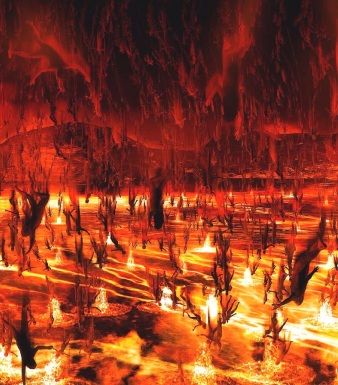 German Cardinal R. Marx has introduced blessing ceremonies for homosexual couples as part of pastoral care. The priest who wants to administer this new “sacrament” will be authorized by his bishop. (Britain’s newspaper Catholic Herald, Bayerischer Rundfunk (Bavarian Radio), 3 Feb 2018).
Patriarch Kirill has likewise joined the promotion of homosexuality in the Council of Europe.
What is the attitude of the Scripture and the Tradition of the Church?
Quote by the Apostle Peter: “Turning the cities of Sodom and Gomorrah into ashes, God condemned them to destruction, making them an example to those who afterward would live ungodly.” (2Pe 2)
Quote by the Apostle Jude: “In a similar way, Sodom and Gomorrah and the surrounding towns gave themselves up to sexual immorality and perversion. They serve as an example of those who suffer the punishment of eternal fire.” (Jud 1)
Is Francis a heretic or not?
7 October 2017
 In his Exhortation Amoris Laetitia, Francis de facto subverted the existence of universally valid moral norms and instead of objective facts he promotes mere subjective attitudes resulting in the abolition of God’s laws. He hypocritically calls it “mercy”. Czech bishop Holub, in contrast to the signatories of the Correction, covers up and advocates the heresies of Francis.
Quote by T. Holub (taken from Czech Radio): “The risk is that there is a notion of absolutely unchangeable teaching which ended with John Paul II, and then there has been some change coming with Francis. But it is exactly in family matters that the evolution of how to treat people in very difficult situations can be perfectly seen in the Church.”