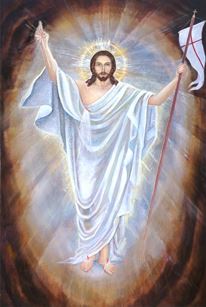
Reflection on Jn 17:11
“And I am no longer in the world, but they are in the world, and I am coming to You.
Holy Father, keep them in Your name, which You have given Me,
that they may be one, even as We are one.”
 Some translations of Jn 17:11 read “whom You have given Me”, referring to the disciples, instead of “which You have given Me”, referring to the name of the Father. We use the correct translation based on the Greek original, and we will use these words in our prayer stops.
The name which the Father has given to the Only-Begotten Son fully reveals the mystery of the divine name. God revealed the depth of the divine name to Moses only partially in the burning bush. It is contained in the name Yahweh, or I AM WHO I AM, or I AM HE WHO IS. It expresses that God is almighty, that He has always existed and that all that exists was given being by Him.
Jesus used the name I AM several times so as to reveal the truth and the mystery of Him being the Son of God who is one with the Father as to His divinity. He said: “I and the Father are one.” (Jn 10:30) And in another place: “Before Abraham was, I AM.” This evoked an instinctive emotional response of the Jews who considered it blasphemy and wanted to stone Him. On the evening before His death, when Jesus spoke about the deep truths at the Last Supper, He prayed to the Father in the end. In this prayer, He points out the deep mystery of His name which is identical with the name of the Father. The name Yehoshua means “HE WHO IS is (our) salvation”.
By assuming a human nature, the Son of God revealed to us His and the Father’s – i.e. God’s – love, mercy and salvation. The name Yehoshua, i.e. Lord (Yahweh) is salvation, is also the name of the Father, which He gave to His Son when He sent Him to us. Jesus received this mission, and He became our Salvation. So this name is deeply related to every one of us. Certainly, the name Yahweh is related to each of us as well because we all were created by God and given being by Him and not by ourselves. After the first sin, when death and slavery of the devil spread to all human generation, the second divine Person, the Son, becomes man and becomes our salvation.
The words of Jesus: “I and the Father are one” express the fact that Jesus is of one Being with the Father. “Whoever calls on the name of the Lord shall be saved.” In verse 26, Jesus says: “I made known to them Your name…” – the name of the Father which He has given to His Son. This name is: Lord (Yahweh) is Salvation, which is contained in the name Yehoshua. That is also why e.g. in Russia or Ukraine, but also in Israel, the son bears the name of his father as part of his name, such as “Simon son of Jonah”, Russian “Andrey Vladimirovich”, and in other nations too the son’s name is derived from the name of his father.
Jn 17:11 in the Greek original reads: “…keep them in Your name, which You have given Me…” It means that the disciples must be kept in the name of the Father, which Jesus bears. Verse 12 continues: “While I was with them, I kept them in Your name, which You have given Me.” So again, the Greek original uses a pronoun which expresses that the meaning of the words “which You have given Me” refers to the name and not to disciples. Some translators use a version which is also acceptable in the Greek original but only as secondary: “…keep them (disciples) in Your name whom (disciples) You have given Me”.
Verse 26 specifies the primary meaning of verse 11 which shows that Jesus has made known the Father’s name in His name: “I made known to them Your name, and I will continue to make it known.” So this indicates a process of knowing the depth of the name of God – Yehoshua, which Jesus makes known through the Holy Spirit. This knowledge is connected with the love of the Father towards the Son as well as the love of the Father and the Son towards us. The culmination is the dwelling of Christ in the soul of a disciple which is conditioned by the process of knowing the divine name ever more deeply.
The Hebrew expression Yeshua is a shortened form of the full name Yehoshua. The Greek translation Isus, Ukrainian Isus, Czech Ježíš, Polish Jezus, or English Jesus is derived from the shortened form Yeshua. This shortened form does not fully express the nature of the name Yehoshua. The divine name Yehoshua refers to the Holy Trinity – the Father, the Son and the Holy Spirit, but it also expresses the relation to our salvation. Yehoshua can be translated as Lord (Yahweh) is my salvation.
Conclusion: Saint Francis began to say the Lord’s Prayer and uttered the first word “Father”. He uttered it in the evening, and in the morning he still repeated the same word slowly, groaning, with his hands lifted up. All through the night he did not even continue the next words of the Lord’s Prayer.
God revealed His name to us. When we call a person by name, he responds to it, we come into contact with him through our eyes or gestures and build a personal relationship with him. But not so with God. We do not have a personal relationship with God. We call Him by name and yet we do not feel the need to enter into His presence, to realize that He hears us, sees us and waits for us to say to Him why we are calling on Him. And it never even occurs to us that God is waiting. We keep on talking to ourselves, without any personal contact. That is why it is so important to learn to enter into the presence of God whenever we call on His name. Uttering the syllables “YE”, “HO”, “SHU”, enter into a relationship with the Father, the Son and the Holy Spirit, and pronouncing longer the vowel “A” remain in this relationship and give yourself wholly to God.
Download: Reflection on Jn 17:11