Is the priest T. Halík a heretic? /Part 2/
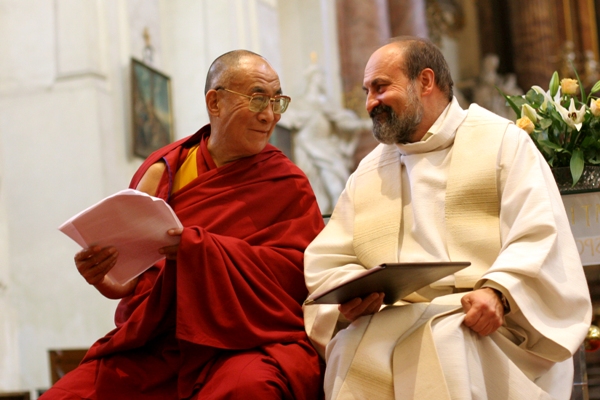 Catholics want to be clear about whether the Catholic priest Halík is a true-Catholic priest or a heretic. He cannot be both this and that, even though he claims to be.
The second method used by Halík is:
2. Method of ridicule
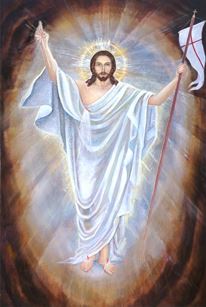
Halík ridicules the truths of faith, and even calls the Resurrection of Christ a myth and fairy tale with a happy ending.
Quote: “The Easter story can be read in two quite different ways. Either as a drama in two acts, where in the first act a just and innocent man is sentenced to death and executed, and then, in the second act, is resurrected and accepted by God. … In the first interpretation the ‘Resurrection’ is the happy ending, and the entire story is a typical myth or optimistic fairy tale.” (Night of the Confessor, 2006)
Quote: “The Easter story…”
Response: Halík’s term “Easter story” reveals his attitude towards the most fundamental truth of the Christian faith. He places it on a level with pagan myths and non-binding human stories. Halík does not distinguish between the inspiration of the Bible and so-called sacred texts of false pagan myths. He thus places the question of salvation and perdition on the same level. Halík’s approach to the fundamental truths is heretical.
Quote: “The Easter story can be read in two quite different ways.”
Response: This is Halík’s next totally heretical assertion. We cannot read the fundamental truth of our salvation in two ways, let alone quite different. It would be spiritual schizophrenia. However, this is what Halík demands from his readers. The death and Resurrection of Christ definitely assures our salvation. I either accept or reject this historical reality, the foundation of the saving faith, but I cannot understand it in two ways, much less in completely different ones!
Quote: “…in the first act a just and innocent man is sentenced to death and executed, and then, in the second act, is resurrected and accepted by God.”
Response: Halík now imposes a heresy that Christ is a mere “man”, although a “just and innocent” one. He thus denies the fundamental truth of Christianity that Christ is both true God and true man. This was also denied by heretics in the early centuries, such as Gnostic teachers Marcion, Valentinus… If Halík denies the Divinity of Christ, just as the arch-heretic Arius, he also denies the fact that the Divinity of Christ participates in the reality of the Resurrection. God (the Father) raised Christ (Acts 2:24.32), and at the same time Christ rose by His own divine power (Rom 14:9). Halík denies the very reality of the Resurrection and hence the almighty power of God (Creed: “I believe in God, the Father Almighty, Creator of heaven and earth”). Halík does not believe in the real Resurrection. His attitude is a super heresy.
He turns the mystery of our salvation into a kind of pagan drama in two acts. Halík’s way of expression is in itself psychological manipulation which degrades the fundamental truths of faith. Halík ridicules the foundation of the faith, and if anyone believes in these fundamental truths, he labels him as a fundamentalist, a bigoted Catholic or even an intolerant fanatic. Christian fundamentalism, however, which Halík unjustly condemns, is nothing else than the fundamental truths of the faith resulting in the love of God and neighbour. To create the impression that this true Christian fundamentalism has the same spirit as the terrorism of Islamic fundamentalists is cunning manipulation. All the apostles and saints were fundamentalists because they built on the foundation of the truth of faith and pure love.
Quote: “In the first interpretation the ‘Resurrection’ is the happy ending, and the entire story is a typical myth or optimistic fairy tale.”
Response: This is the supreme heresy, the height of heresy. Whoever says this is automatically excluded from the Church of Christ and becomes an apostate. Of course, Halík will equivocate again and claim that he said nothing like that, that it is only “one of the possible approaches”.
To call the fundamental truth of the Resurrection a “happy ending”, “story”, “typical myth” or “optimistic fairy tale” is degradation of Christianity! Even the greatest heretics did not manage to do so in such a venomous and artful manner. Sad to say, Halík’s heresy was given a blessing by Card. Vlk, wherefore both of them fell under an anathema according to Gal 1:8-9 (29 June 2008).
Halík approaches the Gospel as something foreign to him, something that does not concern him personally at all and is not at all important for him; he does not accept it as the Good News of his Saviour. He assumes a Buddhist attitude of a kind of detachment and symbol. It is strange that Halík’s book “Night of the Confessor” does not speak about sin at all, about its consequences for the human mind or human life, and especially about its impact, which is eternal damnation and loss of communion with the righteous God. Without true awareness of the reality of sin, man feels no need of the Saviour. Halík totally boycotts the fundamental truths of the faith: the reality of sin, the need for repentance and conversion, the reality of salvation in Christ, and acceptance of Christ as personal Saviour and Lord.
The fundamental truths of our salvation contained in the death and Resurrection of Christ are characterized by Halík as follows: “…the ‘Resurrection’ is the happy ending, and the entire story is a typical myth or optimistic fairy tale.” Whoever accepts the reality of the Resurrection finds himself, in Halík’s view, in the position of a primitive man who takes seriously myths and fairy tales with a happy ending. He thus ridicules the Resurrection and psychologically does not permit anyone to receive this reality as it has been preached by the Church throughout the two millennia. He does not give man a minimal chance to take the Resurrection of Christ as it is. Using psychological manipulation, he presents those who receive the truth of the Resurrection as fools and dangerous fundamentalists. He manipulates human pride – people do not want to be humiliated and so they pretend to be on a “higher” level by not believing in the Resurrection as such but transposing it according to Halík’s gnostic higher knowledge.
Halík continues his exegesis: “I can hear a story like that and think to myself that that was more or less the way it happened (which people confuse with ‘faith’), or I can conclude that it didn’t happen like that – or at all (which people confuse with ‘lack of faith’).”
Quote: “I can hear a story like that and think to myself that that was more or less the way it happened…”
Response: Speaking about the fundamental reality of the death and Resurrection of Christ, Halík uses the expression “a story which I can hear and think to myself that that was more or less the way it happened”. Thus, the Gospel – the Good News of our salvation confirmed by eyewitnesses – the apostles and the generation of early Christians and millions of martyrs who laid down their lives for its sake, is referred to by Halík as “a story” about which I can think anything I like. This may be an approach of a Buddhist or Hindu or a voodoo sorcerer who, living in the darkness of paganism, can think anything he likes, but not of a Catholic priest who acts as a media spokesperson for Catholicism in the Czech Republic. Halík’s terminology is already in itself completely heretical and introduces heretical thinking and heretical attitude. So Halík is really a heretic par excellence.
Whoever has believed in Christ is bound by the Gospel and the Word of God. He cannot think anything he likes about the testimony of the truth, as Halík suggests. Halík’s position is completely contrary to the position of the Christian faith.
Quote: “…or I can conclude that it didn’t happen like that – or at all (which people confuse with ‘lack of faith’).”
Response: Halík offers a series of doubts: 1) it didn’t happen like that (i.e. according to Scripture), 2) it didn’t happen at all. Halík uses theatrical expressions, such as “a story taking place”, “a drama in two acts”. His theatrical approach is unrealistic and unhistorical. It is another heresy, blasphemy and mockery of the fundamental truths of salvation. Halík says that if we think to ourselves that the fundamental truth of the faith did not happen, ergo, if we do not believe in it, we “confuse it with lack of faith”. No, we do not confuse it – this indeed is real lack of faith!
Halík’s gnostic thinking is at a “high” level, which we, primitives, cannot understand. But “if you confess with your mouth Jesus as Lord (God) and believe in your heart that God has raised Him from the dead, you will be saved” (Rom 10:9). We can fully understand this! Halík does not recognize this faith in the Resurrection of Christ as faith and says that people “confuse it with faith”. But we do not confuse it with faith; it really is the saving, Christian faith. What is, in Halík’s view, true faith and what is lack of faith? According to Halík, we confuse everything and he alone is a “know-all”. He suffers from a typical “know-all” syndrome.
Christianity is not about accepting some nonsense, artificial paradoxes, myths or fairy tales, as suggested by Halík. The Christian faith presents reasonable, true realities and if one accepts them, one has the strength to live a true and righteous life. Halík’s philosophizing and theologizing is not an innocent thing. If he, being a priest and a member of the Masonic EU Committee of Wise Persons, opens the door for this spirit of the New Age to penetrate into Christianity, hundreds of thousands of souls will go to eternal perdition, and this is no trifling matter! Similarly, the “innocent” philosophies of two Germans Nietzsche and Marx, which were politically embodied in Marxism and fascism, brought millions of victims which ended at the war fronts and in crematoria in the concentration camps. Halík acts in the name of the Church and has proclaimed these dangerous heresies with impunity for 26 years!
Conclusion: What is a sect from the Christian point of view? And who is a sectarian? A sectarian is one who proclaims heresies which separate him from the orthodox doctrine. Halík has become the founder of a modern Gnostic sect. All who accept his heretical teachings and his antichristian spirit belong to this sect.
+ Methodius OSBMr + Timothy OSBMr
Secretary Bishops of the Byzantine Catholic Patriarchate
http://vkpatriarhat.org/en/?page_id=9564
24 January 2016
Download: Is the priest T. Halík a heretic? /Part 2/ (24/1/2016)